





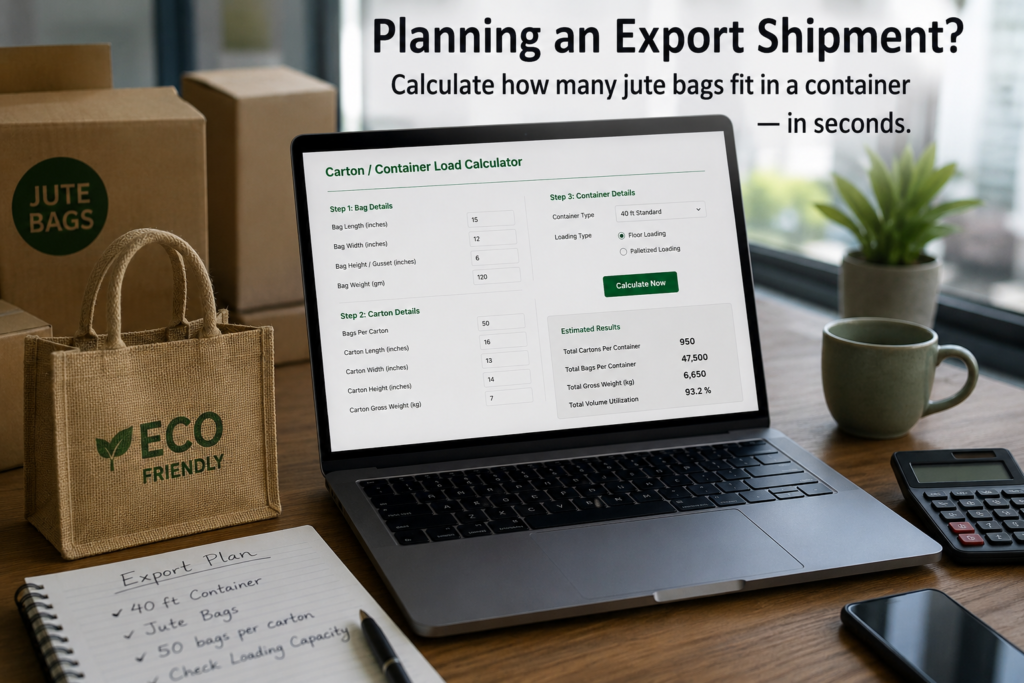
“Do you have any software that can tell me exactly how many bags will fit into a 40-foot container?”
That was the question I received from a prospective customer in the United States.
At first, it sounded like an ordinary inquiry. As a manufacturer and exporter of eco-friendly jute and cotton bags, we receive questions every day about pricing, production time, printing options, and shipping schedules.
But this question was different.
The buyer wasn’t asking about the bags.
He was trying to solve a logistics problem.
His company imports eco-friendly shopping bags from different manufacturers in Asia. Before confirming an order, they needed to estimate how many finished bags would fit inside a 20-foot or 40-foot container. The answer would determine their landed cost, warehouse planning, and even the final selling price in the U.S.
Like many importers, he had tried doing the calculations manually.
There were Excel spreadsheets.
There were handwritten calculations.
There were rough sketches of cartons inside containers.
There were online volume calculators.
Yet none of them answered the one question he really cared about:
“How many finished bags can I actually load into one shipping container?”
Most calculators only estimate cubic meters (CBM). They don’t consider the complete packing configuration—bags inside cartons, cartons inside containers, palletized or floor-loaded shipments, carton dimensions, gross weight, or different container sizes.
After spending hours searching online, he came across a free tool on our website.
He decided to give it a try.
Within a few minutes, he entered:
- Bag dimensions
- Quantity per carton
- Carton dimensions
- Carton weight
- Container type
The calculator immediately generated the estimated container loading capacity.
His response surprised us.
“This is exactly what I was looking for.”
For someone working in exports, that sentence meant a lot.
Why This Problem Is More Common Than People Think
Many people assume that shipping calculations are simple.
They are not.
Jute and cotton bags are lightweight products, but they occupy significant volume. In logistics, this means shipments usually reach the container’s cubic capacity long before reaching the maximum permissible weight.
A small change in carton dimensions can increase or reduce the number of cartons loaded into a container by hundreds.
Likewise, changing from palletized loading to floor loading can significantly increase container utilization.
These small decisions directly affect:
- Freight cost per bag
- Total shipment value
- Warehouse storage planning
- Inventory management
- Profit margins
Unfortunately, many buyers still rely on rough estimates or outdated Excel sheets.
What Information Do You Actually Need?
To estimate container capacity accurately, you only need a few basic details:
- Product dimensions
- Product weight
- Number of bags per carton
- Carton dimensions
- Carton weight
- Container type (20 ft, 40 ft, or 40 ft High Cube)
Once these values are available, the calculations become much easier.
The challenge is not the mathematics.
The challenge is having a tool that performs all the calculations instantly.
A Better Alternative Than Manual Calculations
Instead of drawing container layouts or creating complicated spreadsheets, our online calculator performs the calculations in seconds.
Users can compare different scenarios, such as:
- Different carton sizes
- Different quantities per carton
- 20 ft vs 40 ft containers
- Standard vs High Cube containers
- Alternative packaging configurations
This allows buyers to identify the most economical loading option before production even begins.
Many users discover that a slight modification in carton size can increase the number of bags loaded into a container without increasing shipping costs.
Those improvements may appear small individually, but over multiple shipments each year, they can save thousands of dollars.
Real Value Comes Before the Purchase
One thing we’ve learned after years of manufacturing and exporting eco-friendly bags is that buyers don’t always need another supplier.
Sometimes they simply need reliable information.
Whether they eventually buy from us or from another manufacturer is their decision.
If a free tool helps them plan shipments more efficiently, reduce freight costs, or avoid expensive mistakes, then the tool has already fulfilled its purpose.
That was exactly what happened with our U.S. visitor.
He wasn’t searching for a manufacturer.
He was searching for a solution.
Why We Built This Free Calculator
As exporters ourselves, we’ve faced the same questions countless times.
How many cartons fit inside a 20-foot container?
Would a 40-foot High Cube reduce shipping cost per unit?
Should the shipment be palletized or floor-loaded?
Is changing the carton size worthwhile?
Instead of answering these questions repeatedly through emails, we decided to build a simple online calculator that anyone could use—buyers, exporters, sourcing agents, freight forwarders, and logistics professionals alike.
There is no software to install.
No spreadsheet to download.
No registration required.
Simply enter your packing details and receive an instant estimate of your container loading capacity.
Final Thoughts
International trade is becoming increasingly data-driven.
Small improvements in packaging and container utilization can create significant savings over the course of a year.
If you’re involved in exporting or importing jute bags, cotton tote bags, canvas bags, or other textile products, taking a few minutes to calculate container capacity before confirming production can help avoid costly surprises later.
Sometimes, the most valuable business tools are also the simplest ones.
And occasionally, all it takes is one online search by a buyer on the other side of the world to remind us why building practical tools matters.
About the Author: This article is written by Bidyut Dey, who has over 20 years of practical experience in export-import business. The information shared here is based primarily on real business experience, supported by continuous learning and research. You can learn more about my professional background, experience, and verification links on my About Bidyut Dey page.