





(Upated : 13-08-2026) If you are planning to import wholesale jute bags, India is one of the important sourcing countries to consider. A reliable jute bags supplier from India can provide everything from simple promotional totes to laminated shopping bags, wine bags, gift bags and customized private-label products. India also has a long-established jute manufacturing and export industry, particularly in West Bengal.
However, finding a dependable jute bags exporter from India is not simply about choosing the lowest quotation. Fabric quality, bag construction, printing, MOQ, production capacity, quality control, export documentation and delivery schedules all affect the success of an international order.
This guide explains what overseas buyers should know before sourcing jute bags from India.
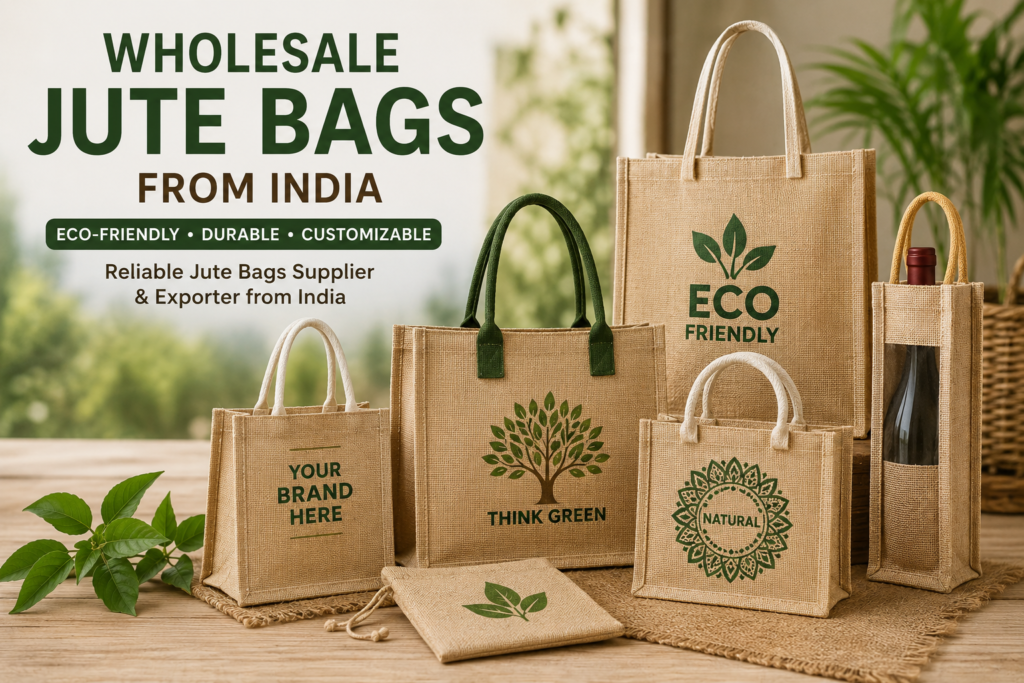
1. Why Source Wholesale Jute Bags from India?
Jute is one of the world’s best-known natural fibres and has been used commercially for generations. It is commonly known as hessian in some markets and burlap in others.
India has a particularly well-developed jute industry. According to the Office of the Jute Commissioner, India exported 192.08 thousand tonnes of jute goods worth ₹32.51 billion during FY2024–25. The export basket included hessian, sacking, yarn and other jute products.
IBEF, using DGCIS data, reports India’s jute exports at approximately US$229 million in FY2024–25, compared with US$204 million in FY2023–24. The USA was the largest destination for India’s overall jute-goods exports, followed by markets including France, Ghana, Germany, the UK, Netherlands, UAE, Australia and Spain.
This established export market is important for overseas buyers. You are not sourcing from an industry that is just beginning to develop an export capability.
Why are jute bags popular?
Jute bags are used for:
- Retail shopping
- Supermarkets and grocery stores
- Promotional campaigns
- Corporate events
- Conferences and exhibitions
- Wine and bottle packaging
- Corporate gifting
- Private-label brands
- Food and speciality-product packaging
- Eco-conscious retail businesses
They also provide a useful surface for branding. A well-designed printed jute bag can continue promoting a business long after the original purchase.

2. Understanding Jute Fabric and Bag Quality
One reason buyers sometimes have difficulty comparing jute bag quotations is that jute bag quality is not determined by size alone.
A lightweight promotional tote and a heavy-duty laminated shopping bag may look similar in a quotation, but their raw-material consumption and manufacturing costs can be very different.
Jute fibre is processed into yarn and then woven into fabric. The quality and fineness of yarn, the weave, fabric weight and finishing all influence the appearance and strength of the finished bag.
For shopping and promotional bags, finer and more attractive fabric is generally preferred compared with the heavier jute fabrics traditionally used for packing sacks.
What should an importer specify?
Before asking for prices, provide:
- Finished bag dimensions
- Gusset size
- Fabric composition
- Fabric GSM
- Handle material and length
- Printing method
- Number of printing colours
- Lining or lamination
- Stitching and reinforcement
- Packaging
- Quantity
- Destination country
- Required delivery date
A quotation based only on the words “good-quality jute bag” is difficult to compare.
3. Types of Wholesale Jute Bags
Indian manufacturers can produce many different styles depending on the intended market.
| Type | Common application |
|---|---|
| Plain jute tote | Shopping and promotion |
| Laminated jute bag | Retail and grocery |
| Juco/cotton-jute bag | Premium retail and promotion |
| Jute wine bag | Wine and bottle gifting |
| Jute gift bag | Corporate and seasonal gifting |
| Drawstring jute bag | Gifts and packaging |
| Heavy jute bag | Strong shopping and packaging |
| Custom printed jute bag | Retail and brand promotion |
Lamination is commonly used when buyers require additional resistance to moisture. However, a laminated jute bag should not automatically be described as completely biodegradable because the lamination may contain synthetic material.
This distinction is important when selling jute bags in environmentally conscious markets.

4. Custom Printing and Private-Label Jute Bags
Most international buyers purchasing wholesale jute bags want some degree of customization.
Depending on the product and artwork, suppliers may offer:
- Screen printing
- Digital printing
- Transfer printing
- Multicolour printing
- Printed panels
- Woven labels
- Brand tags
- Custom handles
- Special colours
- Individual packaging
Jute is a natural textured fabric, so printing on it is different from printing on a smooth synthetic surface.
For this reason, buyers should approve a physical sample before mass production, particularly when the logo or corporate colours are important.
A digital artwork approval alone may not show exactly how the final ink will appear on the woven jute surface.
Water-based printing
For buyers concerned about the environmental profile of their bags, it is worth asking the supplier what type of printing inks are used.
Water-based inks can be suitable for many jute-bag applications, but buyers should ask for the actual printing specification rather than assuming that every printed jute bag uses the same type of ink.
5. Quality Control: What Should a Buyer Expect?
Good quality does not happen only during the final inspection. It starts with the raw material and continues through cutting, printing, stitching and packing.
For a typical jute shopping bag, quality checks can include:
- Fabric GSM
- Fabric appearance
- Bag dimensions
- Printing quality
- Handle attachment
- Stitching
- Loose threads
- Uncut threads
- Seam strength
- Lamination, where applicable
- Folding and finishing
- Packing condition
The handles deserve particular attention. A bag may have excellent fabric but still fail in practical use if the handle attachment is weak.
For large orders, buyers can also consider pre-shipment inspection or third-party quality inspection.
6. How to Find a Reliable Jute Bags Supplier from India
There are several ways to build a supplier shortlist.
B2B marketplaces
Alibaba and IndiaMART can be useful starting points because they allow buyers to identify several suppliers quickly.
But marketplace presence should not be treated as proof that a company is a manufacturer or experienced exporter.
Use these platforms to find suppliers, and then verify them independently.
Supplier websites
A manufacturer’s website can help you understand:
- Product range
- Factory location
- Manufacturing capability
- Export markets
- Customization options
- Company history
- Certifications
Look for consistency between the website, quotation, company name, bank details and export documents.
LinkedIn and professional networks
LinkedIn can help buyers identify company directors, export managers and other employees. It can also provide another way to check whether the person communicating with you is genuinely associated with the business.
Industry organisations
India has established organisations supporting jute manufacturing and export promotion. The National Jute Board’s international marketing programme, for example, includes overseas trade fairs and business meetings intended to promote Indian lifestyle and diversified jute products.
Why West Bengal is important
West Bengal deserves particular attention when sourcing jute products because of its long-established jute manufacturing ecosystem.
Kolkata is an important centre for the Indian jute industry, and the Office of the Jute Commissioner is based in New Town, Kolkata.
This does not mean that every good jute-bag supplier has to be located in West Bengal. But for buyers specifically looking for jute products, the region is certainly worth including in a supplier search.
7. How to Check a Jute Bags Exporter Before Ordering
Before placing a substantial order, ask the supplier some straightforward questions.
Questions worth asking
- Are you a manufacturer or trading company?
- Where is your production facility?
- What is your MOQ?
- What is your monthly production capacity?
- How long have you been exporting?
- Which countries do you regularly supply?
- Can you provide samples?
- What is the sample lead time?
- What is the bulk production lead time?
- Which printing methods do you use?
- What quality checks are carried out?
- Can you arrange third-party inspection?
- What export documents can you provide?
- What are your payment terms?
A supplier that gives clear answers to these questions is much easier to evaluate than one that only sends a price list.
Documents buyers may request
Depending on the order and destination market, buyers may request:
- Company registration details
- GST registration
- Import Export Code (IEC)
- Quality certificates
- Product test reports
- Social-compliance certificates
- Factory address
- Export references
Where a certification is important, verify its scope and validity with the issuing organisation rather than relying only on a logo displayed on a website.
8. Red Flags When Buying Wholesale Jute Bags
The cheapest quotation is not necessarily the best quotation.
Be cautious when:
The price is unusually low
The supplier may have quoted a lower GSM, fewer printing colours, a different handle or a different construction.
Specifications are vague
“Premium quality jute” does not tell you the fabric weight, yarn quality, dimensions or construction.
A sample is unavailable
For customized wholesale bags, approving production without seeing a sample increases the risk considerably.
Company details are inconsistent
The company name on the quotation, invoice, bank account and export documentation should be checked carefully.
Delivery dates keep changing
If a supplier cannot give a reasonably clear production schedule before receiving the order, managing a time-sensitive export order may become difficult.
For a new supplier, a trial order can sometimes be a better approach than immediately committing to a very large quantity.
9. Jute Bag Pricing, MOQ and Negotiation
There is no useful universal price for a wholesale jute bag.
The major cost factors include:
- Jute fabric quality
- GSM
- Bag dimensions
- Fabric consumption
- Lamination
- Printing
- Number of colours
- Handle type
- Lining
- Stitching
- Labels
- Packaging
- Quantity
- Freight
The best way to compare suppliers is to give each of them exactly the same specification.
Ask for prices at several quantities, for example:
| Quantity | Request |
| 1,000 pieces | Best price |
| 3,000 pieces | Best price |
| 5,000 pieces | Best price |
| 10,000 pieces | Best price |
This gives you a much better understanding of the supplier’s volume pricing.
How can a buyer reduce MOQ?
If your first order is relatively small, ask whether the supplier can use:
- Standard fabric
- Standard colours
- Standard handles
- Standard sizes
- Existing printing arrangements
- A trial production quantity
A completely new design involving special fabric, colour, printing and packaging will normally require more commitment than an existing standard product.
10. Exporting Jute Bags from India: FOB, CIF, Documents and HS Code
International buyers should compare landed cost, not simply the factory price.
A supplier may quote EXW, FOB or CIF.
| Term | General meaning |
| EXW | Buyer takes responsibility from the agreed seller location |
| FOB | Seller handles agreed export-side obligations up to loading at the named port |
| CIF | Seller includes cost, insurance and freight to the named destination port |
The exact responsibilities depend on the agreed Incoterms® and named place.
For many overseas buyers, FOB can be useful because freight can then be compared separately with the buyer’s preferred forwarder.
Common export documents
Depending on the shipment, documents may include:
- Pro Forma Invoice
- Commercial Invoice
- Packing List
- Shipping Bill
- Bill of Lading or Air Waybill
- Certificate of Origin, where required
- Inspection or test reports, where applicable
- Insurance documentation, where applicable
HS code for jute shopping bags
For Indian export classification, HS/ITC-HS 42022230 covers hand-bags and shopping bags of jute and is listed as “Free” under India’s export policy.
However, buyers should not assume that every jute or jute-blend bag will have exactly the same classification in the destination country.
The final customs classification can depend on the product’s material and construction. The importer should therefore confirm the applicable tariff classification with the exporter and, where necessary, the destination-country customs broker.
11. Shipping Wholesale Jute Bags Internationally
For normal wholesale quantities, sea freight is generally more economical than air freight.
Sea freight
Suitable for:
- Large orders
- Regular imports
- FCL shipments
- LCL shipments
- Non-urgent deliveries
Air freight
More appropriate for:
- Samples
- Urgent replenishment
- Small shipments
- Time-sensitive launches
LCL can be useful when the order is too small to fill a container. However, buyers should check destination handling and other local charges carefully.
The real number to compare is therefore:
Landed cost per bag = product cost + export charges + freight + applicable duties/taxes + destination charges + local delivery.
12. Sustainability and Compliance
Jute has a strong environmental reputation because it is a natural fibre, but buyers should be careful with sustainability claims.
A plain jute bag is different from a PE-laminated jute bag.
A jute bag with synthetic handles, plastic lamination and plastic packaging should not automatically be marketed as completely biodegradable.
Ask the supplier about the actual materials used in:
- Fabric
- Lamination
- Printing
- Handles
- Lining
- Packaging
India’s jute industry has also been developing diversified jute products and jute blends for different applications. The Office of the Jute Commissioner notes, for example, the development of jute-blended yarns and other value-added jute products.
Certifications
Depending on the buyer and destination market, relevant certifications or audits may include:
- OEKO-TEX
- SA8000
- Fairtrade
- Social-compliance audits
- Product-specific laboratory testing
Always check the actual scope of a certificate. A factory holding one certification does not automatically mean every product it manufactures is covered.
13. A Simple Way to Select the Right Indian Supplier
When comparing suppliers, do not make price the only deciding factor.
| Factor | Importance |
| Product quality | Very high |
| Manufacturing capability | High |
| Export experience | High |
| Price | High |
| Lead time | High |
| Communication | Medium-high |
| Documentation | Medium-high |
| Certifications | Depends on market |
The supplier you want is not necessarily the one offering the cheapest bag.
It is the supplier who can repeatedly deliver:
the agreed specification + agreed quality + agreed quantity + agreed price + agreed delivery date.
That is what matters when the bags are going to be sold under your brand or supplied to your own customers.
14. Final Checklist Before Placing Your Order
Before approving mass production, confirm:
- Final bag dimensions
- Fabric composition
- Fabric GSM
- Handle specification
- Printing artwork
- Printing colours
- Lamination or lining specification
- Packaging method
- Quantity
- Production lead time
- Inspection requirements
- Incoterm
- Shipping port
- HS classification
- Required export documents
- Payment terms
- Destination-country requirements
For customized orders, these details should ideally appear in the final quotation or purchase order rather than being left only in email or messaging conversations.
Frequently Asked Questions About Wholesale Jute Bags from India
Shortlist manufacturers through B2B marketplaces, company websites, industry organisations and professional networks. Then check the company’s business details, factory location, export experience, production capability and documentation. Always request and approve samples before placing a substantial customized order.
There is no fixed MOQ for all jute bags. Standard products can normally be produced in smaller quantities than completely customized bags. MOQ depends on fabric, colour, size, printing, packaging and other production requirements. Ask suppliers for both their normal MOQ and whether they can offer a trial quantity.
India exports jute and jute products to many international markets. Major destinations for Indian jute goods include the USA, France, Germany, UK, Netherlands, Australia, Spain and UAE. In FY2025, the USA accounted for about 23.88% of India’s overall jute-goods exports, according to data compiled from industry statistics.
India’s ITC-HS classification 42022230 covers hand-bags and shopping bags of jute and is listed as “Free” under India’s export policy. Importers should still confirm the applicable classification and tariff in their destination country before shipment.
Give every supplier the same product specification and ask for quotations at several quantities. Compare GSM, dimensions, printing, handles, lining, packaging, Incoterms and freight—not just the price per bag. A lower quotation may simply contain a different specification.
es. India has a large and established jute manufacturing sector and a long history of exporting jute products. Official Indian statistics recorded 192.08 thousand tonnes of jute-goods exports worth ₹32.51 billion in FY2024–25. For an overseas buyer, the more important question is finding an exporter whose quality, production capability, pricing and documentation match the requirements of your market.
Conclusion
India offers international buyers a strong sourcing base for wholesale jute bags, particularly for customized shopping bags, promotional bags, private-label products, gift bags and retail packaging.
The advantage of sourcing from an established Indian manufacturer is not simply the availability of jute. Buyers can access a developed supply chain covering fabric, yarn, printing, stitching, finishing and export logistics.
At the same time, choosing a supplier should not be based only on the lowest price.
A successful import order starts with a clear specification, followed by sample approval, supplier verification, quality control and properly agreed export terms.
If you are comparing several jute bags suppliers from India, send each supplier the same specification and compare like-for-like quotations. Check the physical sample, confirm the production schedule and agree on the documentation before production begins.
The objective is not merely to find a cheap jute bag.
It is to find a jute bags exporter from India who can supply the right quality, at the agreed price, in the required quantity and on time—and continue doing so when you place your next order.
About the Author: This article is written by Bidyut Dey who has over 20 years of practical experience in export-import business. The information shared here is based primarily on real business experience, supported by continuous learning and research. You can learn more about my professional background, experience, and verification links on my About Bidyut Dey page