





The market for sustainable packaging is booming as governments and consumers reject single-use plastics. In fact, reports show millions of eco-friendly jute bags being imported into the U.S. and widespread adoption in the EU fortunebusinessinsights.com. Jute – the “golden fiber” – is naturally strong, biodegradable, and reusable, making it a clear plastic alternative fortunebusinessinsights.com. If you’re ready to switch to jute bags for your brand or store, this guide will help you choose the best quality, understand pricing, and order confidently online. We’ll walk you through weave strength, lamination, printing, logistics, and more so you get durable, attractive bags without surprises.
Farmers preparing jute fields. Jute (a long natural fiber) is grown mainly in South Asia and processed into fabrics and bags for durable, eco-friendly packaging.
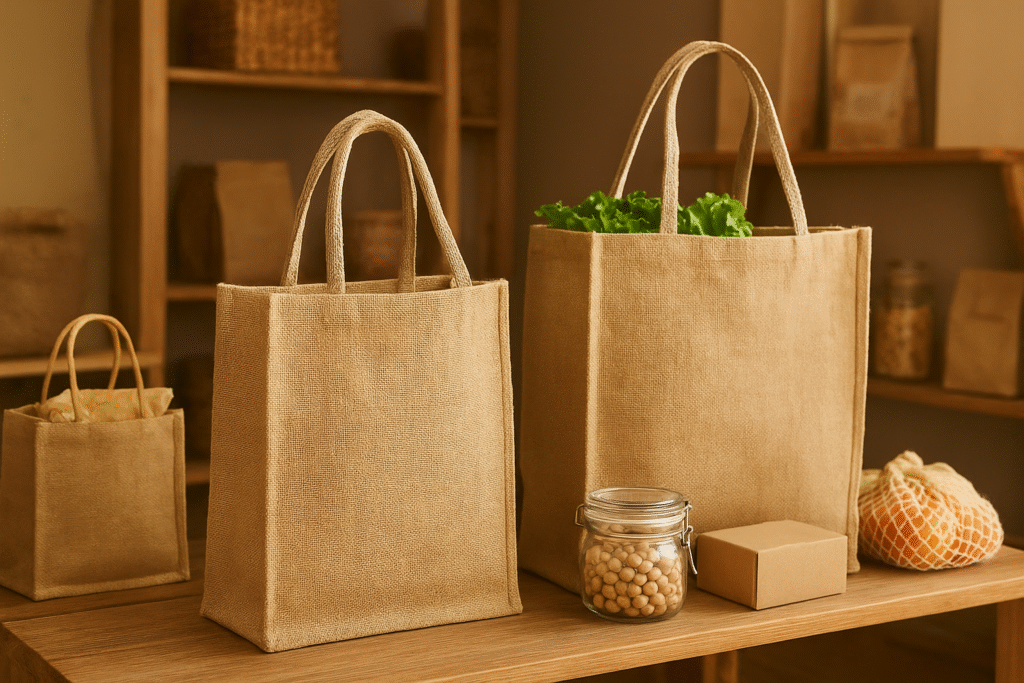
A collection of nice jute bags
Understanding Jute Quality: Weave, Lamination, Handles
Not all jute bags are created equal. A close look at the fabric and construction is vital before you buy in bulk. High-quality jute feels tight and even; cheap jute is rough with gaps. Here are the key factors to check:
- Weave density (Threads per inch): Jute is measured by “portee and shot” (threads per inch). Premium shopping bags usually have a tight weave (often specified as 13×13 or above) that gives a smooth surface for printing. Coarser weaves (e.g. 10×10 or 11×11) show visible gaps and don’t hold fine print well. Always request the P&S count or a fabric sample.
- Lamination (Inner lining): The best reusable jute bags have an inner plastic liner (like LDPE) to make them water-resistant and help the bag stand up on its own. Ask for food-grade lamination if you plan to carry groceries or bakery items – this ensures the liner is non-toxicibef.org. Plain (unlined) jute is lighter and cheaper but won’t resist spills.
- Handles and stitching: Check how the handles attach. Quality bags have reinforced stitching (often “X” or box-stitches) where handles join the body. Look for sturdy options like padded cotton tape (for comfort), thick braided rope (for strength), or flat woven handles. Avoid bags with thin, unbacked handles. A properly sewn jute bag can hold at least 10–15 kg regularly without tearingbenebagscn.com.
In short, demand a sample or detailed specs. Feel the weave, inspect the seams, and open the bag to see the laminate. A good jute bag should feel heavy-duty, with no loose fibers or chemical odors. (Cheap processing can leave a kerosene-like smell – you want a neutral, earthy scent.) By verifying these points before you buy, you’ll avoid weak, falling-apart bags later.

Customization & Printing: Branding Your Jute Bags
When you buy jute bags wholesale, you’re also getting billboards for your brand. The natural golden-brown jute is perfect for logos and text. There are a few printing methods:
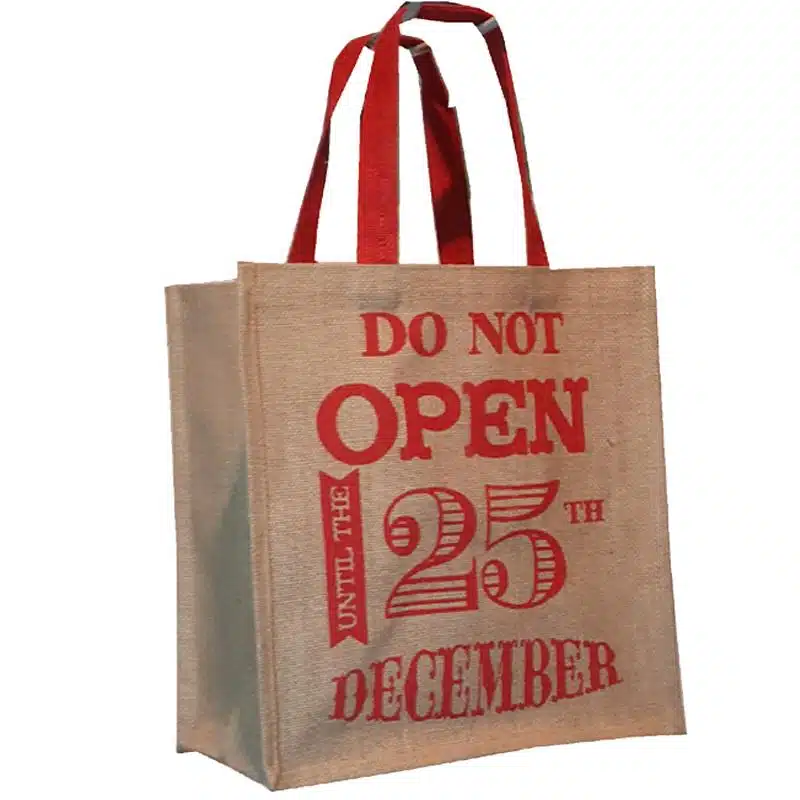
- Screen printing: This traditional method presses ink through stencils onto the bag. It’s very durable and cost-effective for large orders of simple designs. Screen printing works best for solid-color logos or text (typically 1–3 colors). Because jute is textured, bold lines and block colors show up sharply. Screen print is not ideal for photos or gradients, but it is by far the cheapest for basic designsprintbritannia.com.
- Digital / Heat Transfer printing: For complex images, photographs, or multi-color logos, use digital (direct-to-fabric) printing or heat-transfer. These methods can reproduce detailed artwork and gradients. Heat-transfer involves printing the image on special paper and ironing it onto the bag. Digital printing prints directly from the computer. The tradeoff is higher cost per bag, but you’ll get vibrant, photo-quality printsprintbritannia.com.
- Offset printing: Less common, offset can do unlimited colors at lower cost, but the print isn’t as durable on flexible fabric, so it’s rarely used for jute bagsprintbritannia.com.
Tip: Always insist on non-toxic, AZO-free inks for your prints. Standard cheap inks sometimes contain harmful chemicals (AZO dyes) that can fade or be unsafe. Reputable suppliers will confirm their ink is eco-friendlybag-go.net.
Ordering Jute Bags Online: Samples, MOQ, and Shipping
Buying directly from overseas factories (India, Bangladesh, etc.) can save money, but it requires careful steps:
- Get a physical sample first. No matter how clear the mockup is, a real sample is crucial. Pay for one or a few pieces to check the fabric, handle strength, and print quality. Suppliers often deduct the sample cost from your bulk order if you proceed. When the sample arrives, load it with weight, sniff it for off-odors, and wipe it clean. If it passes, you’re good to order a large quantity.
- Understand MOQs (Minimum Order Quantities). Most jute bag factories require a minimum order per style or color – commonly 500 or 1,000 pieces. This is because setting up looms, dyes, and printing screens takes significant time and expense. If you’re a small business, ask if the factory has “ready stock” bags you can buy in smaller lots (sometimes as low as 100) and then have them locally printed. Otherwise, plan for the MOQ or negotiate an order with multiple colors/designs to meet it.
- Clarify shipping terms. International quotes include terms like EXW, FOB, or CIF (Incoterms). In plain language:
- EXW (Ex-Works): You handle all shipping from the factory, including pickup, export clearance, and freight. (High hassle for importer.)
- FOB (Free On Board): The supplier loads the goods on a ship at the port, and you pay for ocean freight. (Most common and safe choice.)
- CIF (Cost, Insurance, Freight): The supplier arranges and pays to get the goods to your destination port. (Convenient but usually costlier than FOB.)
- Shipping method: For large orders, sea freight is by far the cheapest per bagheritagejute.com. It can take ~30–45 days to arrive, so order well in advance. Air freight is faster (a week or two) but often 5–10 times more expensive per kilo. For example, sea shipment of a 1,000-bag order might cost just a few dollars per bag, whereas air might add $5–10 per bag.
By following this process – sample first, meet MOQs, and choose clear Incoterms – you’ll avoid delays, hidden costs, or subpar merchandise. Many buyers report smooth transactions once they insist on a sample, specify all product details (size, GSM, dyes, etc.), and confirm shipping responsibilities in writing.
Why India (and Bangladesh) Are the Jute Hubs
The heart of the jute industry is in the Bengal delta. India and Bangladesh together grow most of the world’s jute. In fact, India alone produces about 75% of global jute outputibef.org. West Bengal state (along the Ganges Delta) accounts for roughly half of India’s juteworldatlas.com – that’s why you’ll find hundreds of jute mills there. Bangladesh (just east of West Bengal) is the world’s second-biggest producer; its fiber is often considered the finest.
Sourcing from India or Bangladesh means you’re buying where the raw material is harvested. This cuts costs and ensures freshness. For example, the national jute board in India notes that “jute… meets all standards for safe packaging” and India is the global leader in jute productionibef.orgibef.org. By working with suppliers in this region, you tap into decades of expertise and get competitive pricing. Plus, many governments (India, Bangladesh, and others) strongly support the jute sector, so factories there often stay up-to-date on eco-friendly practices.
In short, buying from Bengal is buying from the origin. The nearby farms, mills, and government support make it harder for other countries to compete on price or quality.
Ready to Order?
Sourcing wholesale jute bags online can be an economical way to brand your business sustainably. The keys to success are: verify fabric quality (tight weave, quality laminate, strong stitching), insist on safe materials (AZO-free inks, food-grade liners), and order samples before buying big. This approach lets you get sturdy, long-lasting bags (often lasting 1–3 years of usejinyabag.com) that customers will use repeatedly.
Now is a great time to add jute bags to your product line. Browse our catalog to see popular styles and get ideas for printing. Or contact our team for a custom quote – we’ll walk you through sizes, colors, and logos. With quality jute bags, your brand will look good and help the planet at the same time.
Key takeaways: When comparing quotes, remember that thread count (weave) and handle construction are more important than just price. Always request a sample to check print clarity and strength. Ensure the supplier uses food-grade lamination and AZO-free inksbag-go.netibef.org. Factor in sea freight for large orders to minimize per-unit costsheritagejute.com. By partnering with reputable Bengal-based factories (which supply ~75% of the world’s juteibef.org), you position your business to ride the growing wave of eco-friendly packaging trends.
Frequently Asked Questions (FAQs)
A well-made, laminated jute bag can last 1–3 years under regular usejinyabag.com. Jute fibers are naturally very strong – jute bags typically carry more than twice the weight of an ordinary cotton totebenebagscn.com. In practice, a heavy-duty jute shopping bag can handle 10–15 kg regularly. With proper care (don’t overload, keep dry), the bag will retain most of its strength for hundreds of usesjinyabag.combenebagscn.com.
Yes – jute is a pure plant fiber, so it’s fully biodegradablebenebagscn.com. In soil or compost, untreated jute will break down naturally (usually within 1–2 years) and return harmless nutrients to the earthbenebagscn.com. Note: If the bag has an LDPE plastic lining (for water resistance), only the outer jute fabric will decay. The thin inner plastic still needs to be recycled properly. In other words, old jute bags are eco-friendly except for any plastic layer, which is why many buyers ask for biodegradable lamination or simply reuse bags until the lining is worn.
Jute fibers prefer gentle care. We don’t recommend machine washing – the agitation and water can shrink or distort the fiber. Instead, shake out loose dirt and spot-clean gently with a damp cloth and mild soapkingofhandmade.com. You can hand-wash lightly if needed (lukewarm water, no wringing) and let it air-dry thoroughly. Occasional dry cleaning is also safe. Frequent machine washing can cause the bag to lose strength and shape.
After you approve the final sample, expect about 3–4 weeks of production time for an order of 1,000–5,000 bagsbag-go.net. Smaller orders may be faster if the design is already set up. Once shipped, sea freight to Europe/North America can take 30–45 days, so plan ahead. (Air freight is quicker but much more expensive, usually used only for small samples or urgent reorders.) Always clarify lead times and shipping terms (FOB, CIF, etc.) with your supplier before paying.
Sea freight is far more economical for bulky orders. Containers filled with jute bags will cost only a fraction of air freight per kilogramheritagejute.com. For example, shipping 1,000 bags by sea might add just a few dollars to each bag’s cost. The tradeoff is time: sea transit is typically 25–45 days to major ports. If time is not critical, sea shipping dramatically lowers your landed cost.
Yes, but not with standard screen-printing. For photographic quality (fine detail or gradients), you need digital printing or heat-transfer methodsprintbritannia.com. These can reproduce complex, multi-color graphics. Regular screen printing is limited to solid colors (we usually recommend it for logos or simple designs)printbritannia.com. When placing your order, specify “digital heat transfer” if you need a photo or many colors. Note that prices will be higher for these advanced prints.
Natural jute often has a mild earthy or woody scent from the plant’s fibers. This isn’t unpleasant and actually indicates it’s untreated. However, if a bag has a very strong chemical or kerosene-like odor, that usually means poor-quality processing (cheap oils or treatments). To avoid this, buy from suppliers who use high-grade vegetable oil for softening jute and who let bags air-dry properly. A top-quality laminated jute bag should smell only faintly of fresh fiber.
There is no real difference in material – both come from the jute plant. In India and Bangladesh, the raw fiber is called jute, and the rough woven cloth made from it is often called hessian or burlapibef.org. In practice, “jute bag” means the same as “hessian bag” – it’s just terminology. (You’ll almost never see “burlap bag” on most factory sites; they use “jute bag” for consistency.)
They can be, if made properly. Ask for “Food Grade” lamination on the inside lineribef.org. Food-grade LDPE (or even plant-based PLA) linings are designed not to leach toxins into produce. Many grocery chains use laminated jute bags to carry fruits, vegetables, breads, etc. So yes, just specify food-safe lining and ensure the fabric itself is clean (unbleached natural jute).
Absolutely. Because we work directly with manufacturers, we can cut and stitch jute fabric to virtually any dimensions or style you need. Custom sizes generally follow the same MOQ rules (often ~1,000 pieces) due to setup costs. Simply tell us the length, width, gusset, handle type, and any printing details. We’ll confirm the updated MOQ and pricing. Flexibility is one of the major benefits of ordering custom jute wholesale – if you can dream it, a jute supplier can usually make it.
Sources: Industry research and supplier references have been used to verify these details jinyabag.com bag-go.netibef.orgprintbritannia.comheritagejute.combenebagscn.com. All data and quotes above come from up-to-date market reports and manufacturer guidelines (cited inline).
Sources